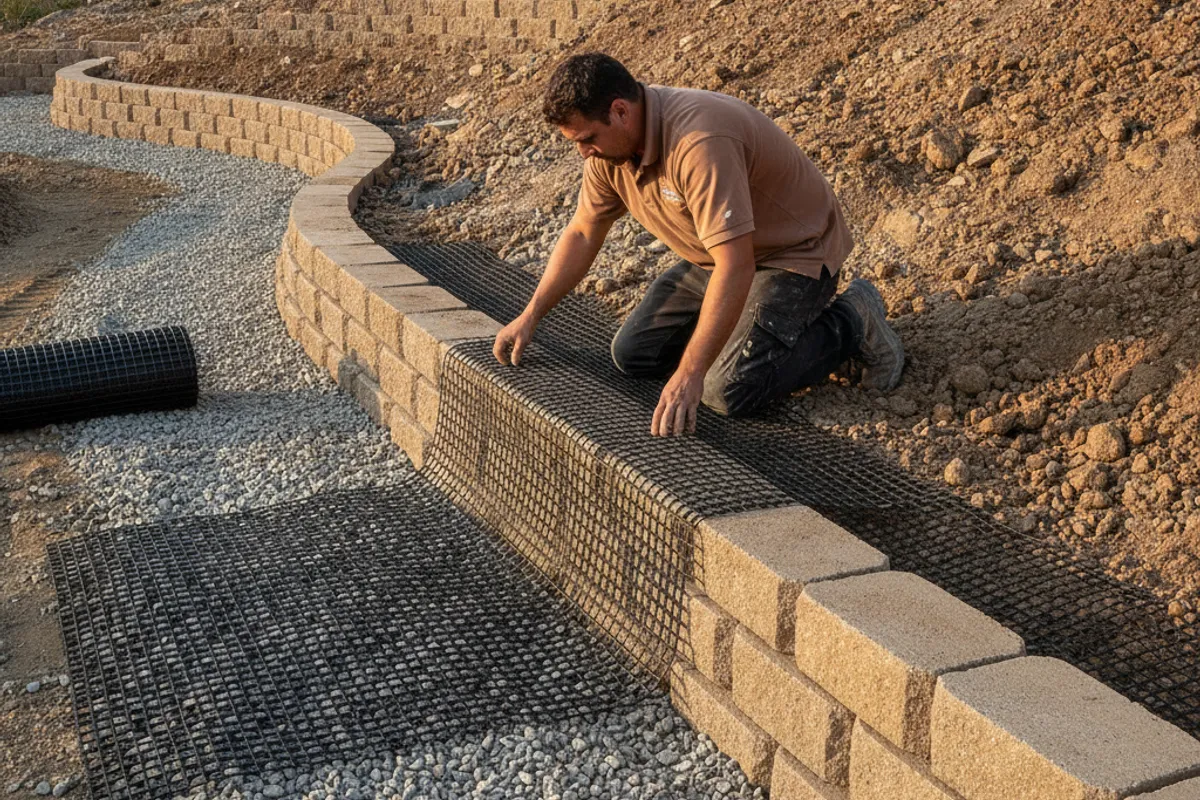
What geogrid is and why it matters for tall walls
Geogrid is a plastic mesh buried in the soil behind a retaining wall so the wall and the soil act as one mass instead of the face fighting the hillside alone. The product, length, and spacing come from the approved design, not a field guess. We do not publish a typical embedment length or a typical course interval for San Diego. Ask for the drawing that names those values.
Without geogrid, a tall retaining wall is a face fighting the lateral pressure of the soil behind it. With geogrid, the grid extends from the face into the retained soil so that mass shares the load. That assembly is a mechanically stabilized earth wall when the design says so.
When geogrid is required in San Diego
A permit does not automatically mean geogrid. Inside City of San Diego limits, Information Bulletin 220 is the permit path. Information Bulletin 221 is grouted masonry, not an SRW geogrid table. The City’s published 221 URL uses a misspelled folder (information-bulletain); ask Development Services for the current bulletin rather than treating that path as a live table. For a segmental wall, the manufacturer drawing and any stamped plan name whether geogrid is in the system, which product, the spacing, and the length.
Ask the bidder to put those values in the written scope. A crew that cannot name them is not quoting the same wall as the drawing.
How geogrid is installed
Geogrid installation follows the wall construction sequence closely.
After placing and leveling the base courses to the first geogrid elevation, the geogrid is rolled out perpendicular to the wall face. It connects to or lays against the back of the block units and extends horizontally back into the excavation. The grid lies flat on the compacted surface.
Backfill is placed over the geogrid and compacted as the design requires. Loose fill over the grid weakens the connection. The next courses are set, and the sequence repeats at each geogrid elevation on the drawing.
The geogrid should not be creased or folded back on itself where it connects to the wall face. The connection between the grid and the block system is where load transfers, and it needs to be placed correctly.
What geogrid does not replace
Geogrid reinforcement does not replace drainage. Saturated soil still adds hydrostatic pressure. Drain rock and a pipe still belong in the scope if the drawing calls for them.
Geogrid also does not replace proper base preparation. If the base course settles because the aggregate base was too shallow or not adequately compacted, the entire wall above it moves. Base preparation and compaction are foundational to whether an engineered wall performs correctly.
How to verify geogrid was installed correctly
Once a wall is backfilled, geogrid is invisible. A contractor who shortcuts the install, shortens the runs, or skips layers will not be found by looking at the finished face.
The protection is the drawing plus whoever is required to inspect the work. Bulletin 220 sends inspections to the City’s inspection list (Information Bulletin 120), not a homemade geogrid schedule. Bulletin 221’s masonry visits apply to grouted masonry, not as a default for every SRW. An SRW geogrid wall follows the inspections that apply to that permit.
If there is no permit, ask the contractor in writing: whether geogrid is included, which product, how many layers, and how far back. Those answers should match the design they claim to follow.
Wall Pro SD connects San Diego homeowners with licensed local crews who build geogrid-reinforced walls to engineering specifications. Call (858) 400-4639 to get connected with someone who can evaluate your wall project and provide a real quote.
For walls that need geogrid reinforcement, see our segmental block walls and Allan Block systems service pages.