Slope stabilization in San Diego County
Slope failures in San Diego County happen fastest on lots where grading, drainage, and ground cover have not kept pace with soil conditions. We connect homeowners with licensed local crews that combine retaining walls, geogrid reinforcement, drainage systems, and ground cover to stabilize slopes before a small creep becomes a significant failure. The right approach depends on soil type, slope angle, and what sits above and below the slope.
Also called: hillside retaining wall, soil retention wall, slope retaining wall. Same work, different words.
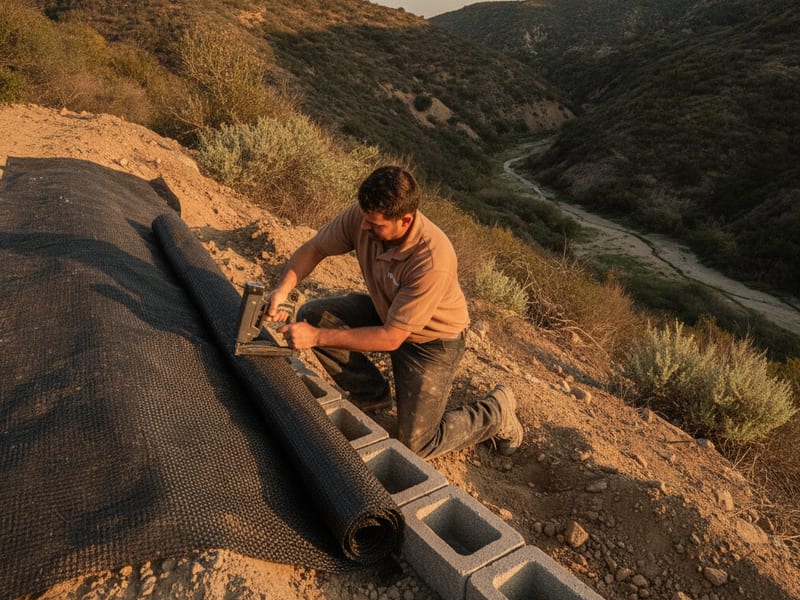
What's included in slope stabilization?
- Assess slope angle, soil type, and failure mode to determine the right stabilization approach
- Install retaining walls at the toe of the slope to stop creep and provide structural base for fill
- Place geogrid reinforcement layers in fill lifts to improve slope mass cohesion above the wall
- Install erosion control blankets, jute netting, or hydroseed on exposed soil above the wall
- Route drainage away from the slope face so irrigation and rain do not saturate the fill zone
- Compact all backfill in lifts to reduce future settlement and slope movement
When do you need slope stabilization?
- Soil is visibly moving, cracking at the crest, or slumping at the toe of a slope
- Heavy rain seasons have caused successive small failures on the same hillside
- Vegetation on a slope has died or burned, leaving soil exposed to erosion
- A new grading or construction project has exposed cut slopes that need stabilization before landscaping
- A slope supports a structure, driveway, or pool above it and needs engineering review before the rainy season
What do homeowners ask about slope stabilization?
What causes slope failures on San Diego hillside lots?
The most common causes in San Diego are inadequate drainage that saturates the soil mass, removal of native vegetation that held the slope, expansive clay soils that shift seasonally, and poorly compacted fill placed during original grading. Coastal and North County lots see marine-layer moisture, while East County lots see wide wet-dry cycles that stress clay soils. Most failures give warning signs before they become catastrophic.
Does slope stabilization always require a retaining wall?
Not always. Mild erosion on a low-angle slope sometimes responds to drainage improvements and vegetation alone. A slope that is actively moving or slumping usually needs a retaining wall at the toe before any fill or ground cover work above it is effective. Your crew assesses the failure mode and recommends the minimum intervention that actually stabilizes the slope.
Do slope stabilization projects require a permit?
Any grading project that moves more than a certain volume of soil or changes drainage patterns generally requires a grading permit in San Diego County. Projects that include retaining walls past the local permit trigger need both a grading permit and structural plans. Your crew identifies what permits apply and handles the submittal. Verify any contractor's license at cslb.ca.gov before signing.
Where do we offer Slope Stabilization in San Diego County?
We match slope stabilization jobs in every city and community in San Diego County. Pick your city for local climate notes and service specifics.
See slope stabilization in all 67 cities
Need slope stabilization in San Diego County?
Call and we match you with licensed local wall crews.