What makes hillside lots in San Diego different
San Diego County has a lot of sloped land. The coastal mesas, inland valleys, and back country terrain mean that a significant share of residential lots have grade changes that require retaining walls to create usable yard space, stable foundations, or safe access. In neighborhoods like Scripps Ranch, Tierrasanta, Rancho Penasquitos, and the canyon-edge communities throughout the county, hillside lots are the norm rather than the exception.
Building on a slope is different from building on flat land in several ways. Soil behaves differently on a slope because gravity is always pulling it downhill. Water moves faster down a slope and concentrates at low points. The act of cutting into a hillside to create a flat building pad creates a new exposed slope face that needs to be stabilized. And the neighbors downhill have a valid interest in whether the slope above their property stays in place.
Before any grading, construction, or retaining wall work on a hillside lot in San Diego, there are a few things worth understanding.
The geotechnical report
For most hillside projects involving significant grading or structural walls, the City of San Diego and other county jurisdictions will require a geotechnical report from a licensed geotechnical engineer. This report characterizes the soil conditions at the site: soil type, bearing capacity, expansion index, depth to bedrock or stable material, and any evidence of historical slope movement.
The report matters for retaining wall design because the engineer designing the wall needs to know what the soil behind it is going to do. Expansive clay soils exert more lateral pressure on a wall than sandy soil does. A slope with a history of movement needs different treatment than a stable cut in decomposed granite.
Geotechnical reports typically run $1,500-$4,000 for a standard residential hillside lot, depending on scope and whether borings are required. For large projects or complex sites, costs can be higher. The report becomes part of the permit application package and the engineer designing the wall uses it as a design input.
Grading permits
Any grading involving more than a certain volume of soil movement in San Diego requires a grading permit, separate from the building permit for structures. The threshold varies by jurisdiction but is generally 50 cubic yards or more of cut and fill, or any grading within certain slope categories.
A grading permit requires a grading plan prepared by a civil or geotechnical engineer, reviewed by the local agency, and inspected during work. The plan shows how the grade change will be managed, where cut material goes, what slopes will be created, how drainage is handled, and what erosion control measures are in place.
Grading without a permit when one is required is a code violation that can require the work to be undone, additional engineering, and penalties. On hillside lots in San Diego, grading and retaining wall work often go together, and the permits for both need to be coordinated.
Retaining wall options on steep slopes
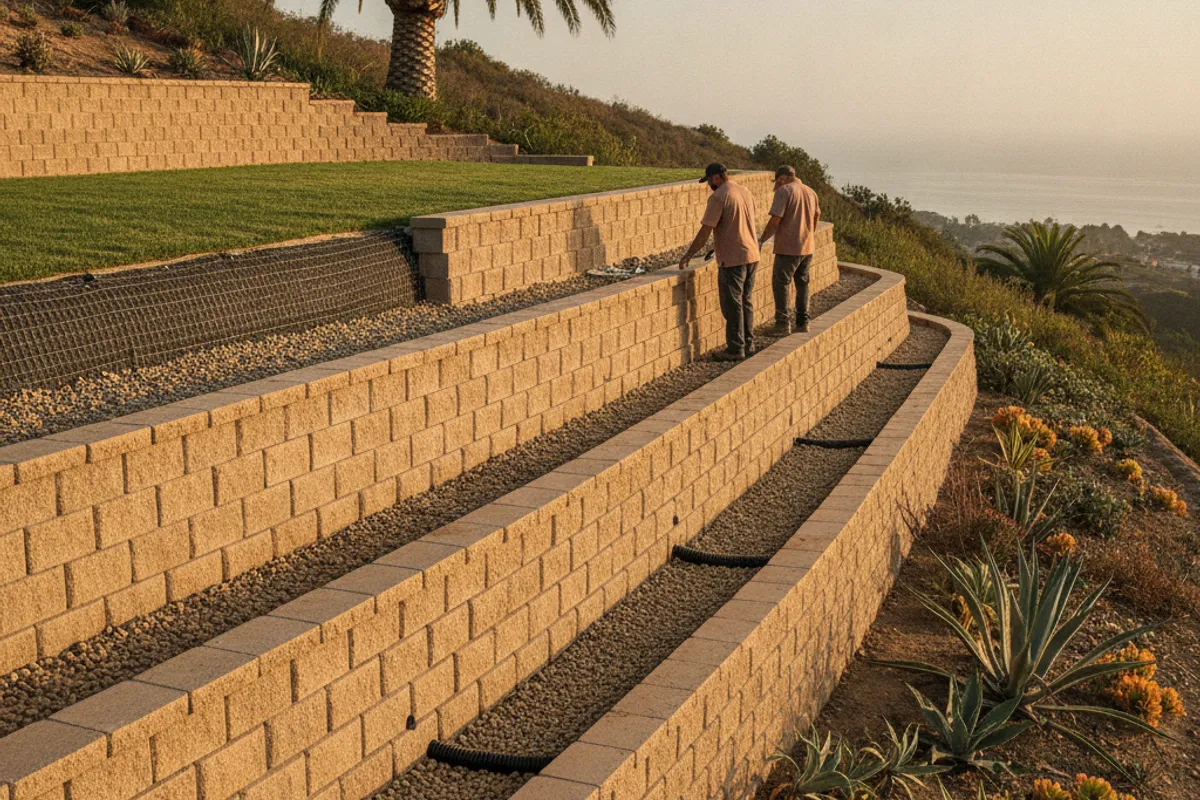
The most common approach to stabilizing a cut slope is a retaining wall, or a series of retaining walls (terraces) that break the slope into manageable sections.
Single tall wall vs. terracing. A single wall holding 10 feet of retained height requires significant engineering, geogrid reinforcement, and a larger budget than two 5-foot walls separated by a bench (flat area) in between. On many San Diego hillside lots, terracing is the practical answer. It distributes the retained height across multiple structures and creates usable flat space between tiers.
Wall placement in a cut. When a hillside is cut to create a building pad or usable yard area, the wall sits at the base of the cut slope. The height of the wall depends on how deep the cut is and whether the face of the slope above the wall is stable on its own.
Wall placement in a fill. On the downhill side of a graded pad, fill material is placed to level out the area. A wall at the edge of the fill holds that fill in place. Fill walls have different engineering considerations than cut walls because fill compaction and settlement behavior is different from native soil.
Setback requirements. San Diego hillside development standards often require walls to be set back certain distances from property lines, from top of slope, or from bottom of slope. These setbacks affect where the wall can legally go and how much usable area is actually created by the grading.
Drainage on hillside lots
Water management is the defining challenge of hillside lot development in San Diego. Rain that falls on a slope needs to go somewhere, and that somewhere should not be through or behind your retaining walls, into a neighbor’s yard, or concentrated against a foundation.
Retaining walls must include drainage systems that capture water behind the wall and carry it to a safe discharge point. But broader site drainage needs to address roof runoff, slope runoff, and any water that moves laterally across the property from uphill.
On most hillside projects in San Diego, the grading and drainage plan addresses all of these as a single integrated system. Swales, catch basins, roof drain outlets, and drain pipes all need to work together to move water through the site without causing erosion or building pressure against structures.
What to do before you start
Before committing to a hillside project, get a site assessment from an experienced local contractor or engineer. They can tell you whether the project is feasible within your budget, what permits are required, and whether there are existing slope stability concerns that need to be addressed first.
An experienced eye on a hillside lot can identify things that are hard to see in photos or from the street: signs of previous slope movement, drainage patterns after rain, soil composition at the surface, and proximity to neighbors or structures that affect the engineering approach.
Wall Pro SD connects San Diego homeowners with insured local retaining wall and grading crews who work hillside lots across the county. Call (858) 925-5546 to get a site assessment for your sloped lot.
Learn more about slope stabilization and terraced garden walls for hillside lots in San Diego.