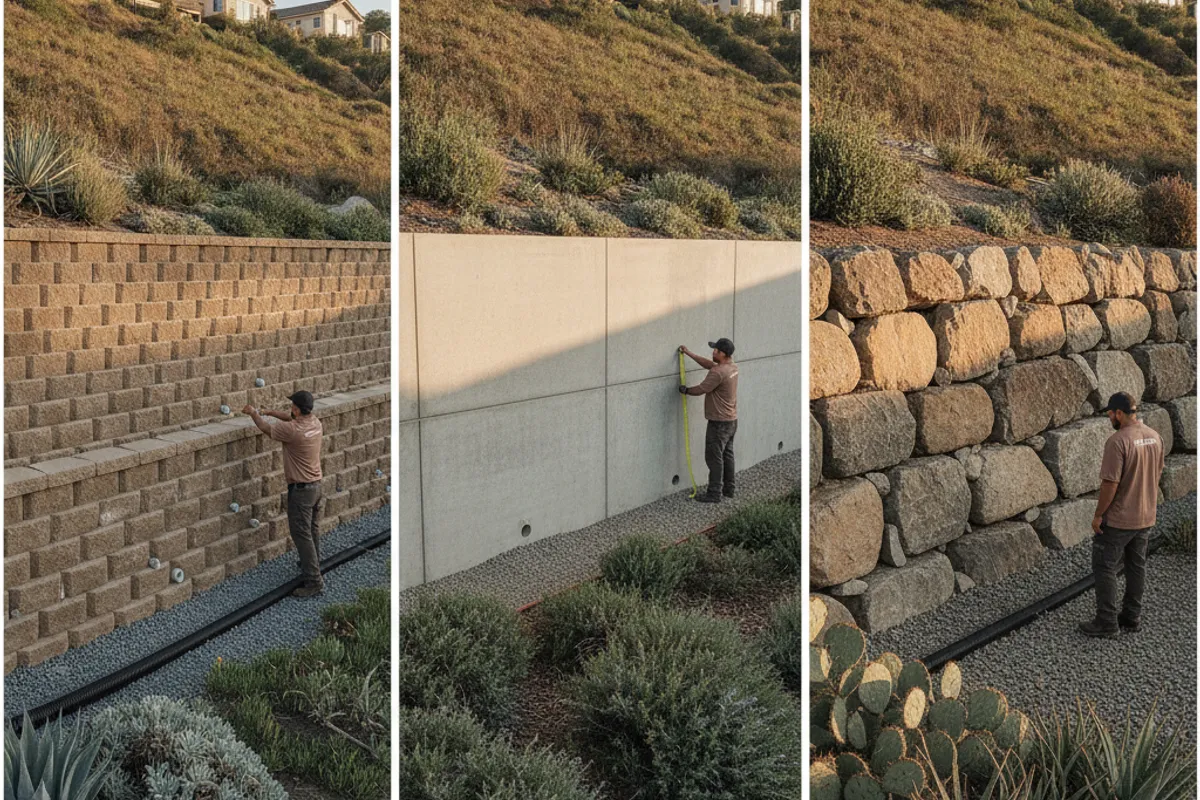
Choosing the right retaining wall material for your San Diego property
When a hillside lot needs a retaining wall, you will hear three materials come up most often: segmental block, poured concrete, and boulders. Each one performs differently, costs differently, and looks different when it is done. The right choice depends on your site conditions, your budget, your timeline, and how the wall needs to perform over the next 30 years.
San Diego’s geology adds some wrinkles. The county’s soils range from sandy beach-adjacent loam in Encinitas to expansive clay in the eastern valleys to decomposed granite and rocky substrate in the back country. What works on a relatively flat lot in Chula Vista is different from what holds on a steep canyon slope in Santee or Tierrasanta.
Segmental retaining wall block (SRW)
Segmental block is the most common choice for residential retaining walls in San Diego, and for good reason. The blocks are concrete units that stack and set back slightly with each course, creating a battered (angled) face that adds structural stability. They lock together without mortar, which means they can flex slightly with soil movement and still hold position.
The practical advantages for local use: SRW walls drain well when properly installed with drain rock and perforated pipe behind them, they handle San Diego’s seasonal wet-dry cycles without cracking, and they can be built in short segments without a crane or concrete truck. A two-person crew can build 30-60 linear feet of short wall in a day with block.
For walls over 4 feet, most SRW systems are designed to work with geogrid, a synthetic mesh that extends back into the hillside and wraps each layer into the soil mass behind the wall. An engineered SRW wall with geogrid can hold retained heights of 8-12 feet when designed correctly.
Cost runs $35-$65 per linear foot for walls under 4 feet, and $60-$110 per linear foot for engineered walls with geogrid, drainage, and a permit.
The one area where block falls short: appearance on premium projects. The ribbed or textured face of most SRW block reads as a standard contractor wall. Higher-end block profiles and cap options exist from manufacturers like Versa-Lok and Allan Block, but at that price point some homeowners in La Jolla or Rancho Santa Fe move toward poured concrete for a cleaner look.
Poured concrete retaining walls
Poured concrete (cast-in-place concrete) means forming the wall in place with wood or steel forms, installing rebar, and pouring concrete. It is the most structurally precise option and allows for custom heights, curves, and smooth finished faces.
For San Diego residential use, poured concrete walls are common in newer construction in Otay Ranch, Eastlake, and the hillside communities of east Chula Vista, where the lots are graded by the developer and the walls are built as part of the initial construction. On existing properties, they are less common for additions or repairs because of the forming labor and concrete delivery access.
The structural advantages are real. A properly designed and poured concrete wall is extremely strong, does not have joints where soil can push through, and when coated or painted can look clean and finished. Poured concrete walls also last longer than block when access to a site is an issue, because there are no individual blocks that can shift or tip.
The trade-offs: poured concrete is significantly more expensive than block for comparable heights, running $60-$120 per linear foot for a typical residential wall. It requires forming that needs access for a truck and typically takes longer to build than a block wall. If it cracks from settling or poor drainage, repair is more difficult than adjusting block.
For walls where appearance matters and budget is available, poured concrete is the premium answer.
Natural boulder walls
Boulder walls use large natural stones, typically granite or sandstone quarried from regional sources, stacked without mortar (dry stack) or with mortar at key joints. They are the aesthetic choice for properties where a wall should look like it belongs in the San Diego landscape.
This is a legitimate engineering approach for walls under 4-5 feet. A dry-stacked boulder wall with good base preparation and proper drainage can hold a hillside for decades. The gaps between boulders also allow drainage naturally, which reduces hydrostatic pressure buildup behind the wall.
For walls over 4-5 feet, boulder walls get complicated. The weight of large boulders requires equipment to place, the engineering calculations are more complex because there are no standardized block units, and a structural engineer needs to evaluate each boulder wall above permit height as a custom structure. That adds time and cost.
Where boulders make sense locally: canyon-edge properties in Tierrasanta, Scripps Ranch, and the communities east of the 15 where the natural landscape is already rocky, rural lots in Jamul, Ramona, and Alpine where a natural look fits the setting, and front yards in neighborhoods where the homeowner wants the wall to be a landscape feature rather than a functional structure in the background.
Cost runs $40-$90 per linear foot for a short gravity wall. Taller engineered boulder walls run $90-$140 per linear foot including equipment and engineering.
Side-by-side comparison
Segmental block: Mid-range cost, fast installation, works well with geogrid for taller walls, good drainage when properly built, adequate appearance for most residential projects. Best all-around choice for most San Diego hillside lots.
Poured concrete: Higher cost, premium appearance, strongest per foot of height, difficult to repair if it cracks, requires more site access. Best for newer construction and high-end projects where appearance and structural certainty matter.
Boulder walls: Highest material and equipment cost, natural appearance, excellent drainage, limited practical height without engineering. Best for rural or canyon-adjacent properties where the natural look is the point.
The decision for your property
For most San Diego homeowners with a hillside lot, a slope to stabilize, or a grading issue, segmental block is the place to start. It is cost-effective, widely understood by local contractors, and handles the geotechnical challenges common in county soils. If the wall is over 4 feet, your contractor will bring in an engineer and the block system will be specified to that engineering.
If appearance is important and budget allows, poured concrete is the upgrade. If your property already has a natural rocky character and the wall is under 4-5 feet, boulders may be the best fit.
Wall Pro SD connects homeowners in Encinitas, La Mesa, El Cajon, Chula Vista, and across San Diego County with insured local retaining wall crews. Call (858) 925-5546 to get connected with someone who can evaluate your specific site.
See our full comparison on the concrete block retaining walls and natural stone retaining walls service pages.