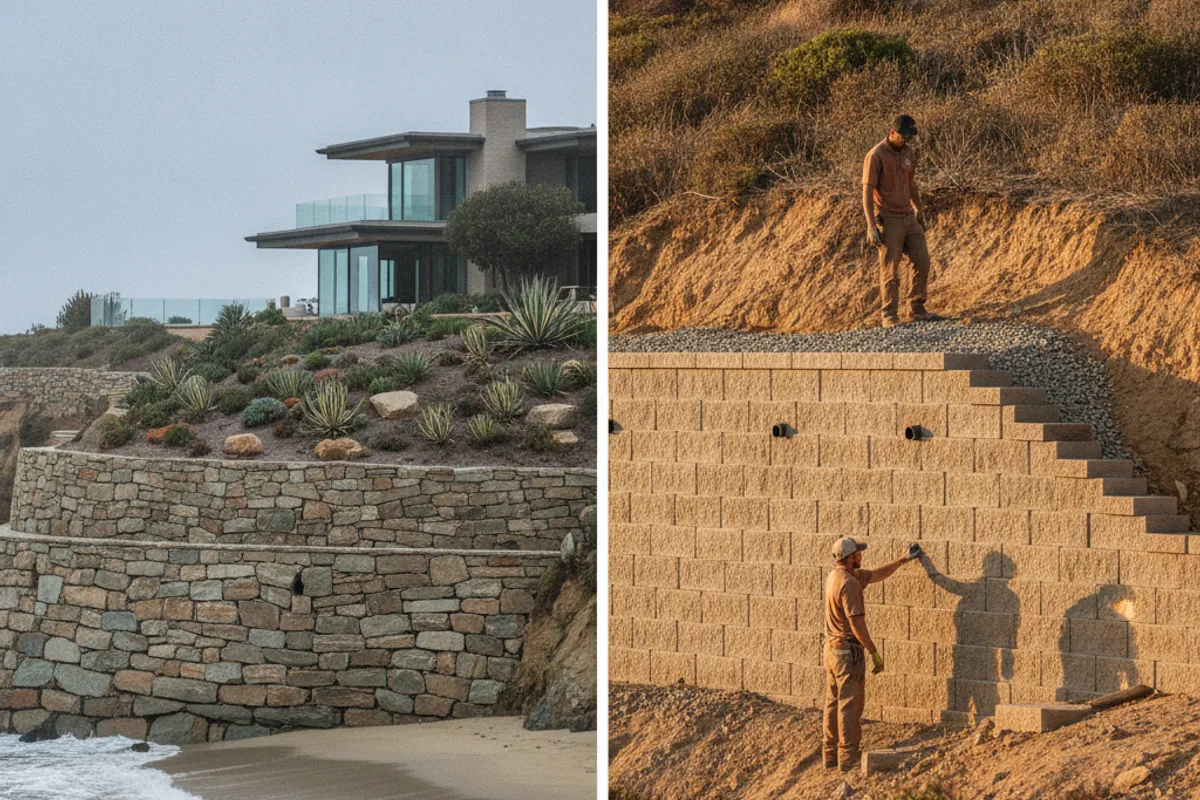
San Diego soils are not uniform, and it matters

Most retaining wall guides treat material selection as a style decision. In San Diego County, it is also an engineering and longevity decision, because the soils and climate conditions vary enough across the county to affect what materials perform well and what materials fail prematurely.

The county spans coastal mesa, interior valley, mountain terrain, and desert edge. A property in Cardiff-by-the-Sea deals with salt air corrosion and marine layer humidity. A property in Ramona deals with summer heat above 100 degrees, cold winter nights, and expansive clay soils in the valley floors. A property in Chula Vista’s newer east-side developments deals with engineered fill over decomposed granite. Each situation has material implications.

Coastal zones: salt air and moisture

In the coastal communities from Oceanside through Del Mar, La Jolla, Pacific Beach, Ocean Beach, Coronado, and Imperial Beach, the defining environmental factor is salt air. Marine layer brings moisture with dissolved sea salt that accelerates corrosion on metals, causes surface degradation on some concrete mixes, and penetrates painted or sealed surfaces over time.

Concrete block (SRW): Performs well in coastal conditions when manufactured with high-quality, dense concrete mix. The main concern is efflorescence (white mineral deposits from water movement through the block), which is cosmetic, and surface spalling if a lower-quality block is used in a high-moisture environment. Specify blocks from manufacturers who produce for coastal markets.

Poured concrete: Dense poured concrete holds up well in coastal conditions, but surface coatings and sealers degrade faster in salt air than inland. Unsealed poured concrete develops surface weathering, but its structural performance is unaffected in most residential applications.

Natural boulders: Granite and local sandstone boulders are highly resistant to salt air degradation. The material is essentially unaffected by coastal conditions, which is one reason boulder walls are common in La Jolla, Encinitas, and Del Mar coastal properties.

Timber and railroad tie walls: Not appropriate for the coastal zone. Salt-laden moisture accelerates rot even in ground-contact treated timber, and timber walls in coastal environments often fail structurally within 10-15 years.

Gabion (wire basket) walls: The steel wire used in standard gabion baskets corrodes in salt air environments. Galvanized or PVC-coated wire extends the lifespan, but gabion walls are generally not the first choice for long-term coastal installations.

Inland valleys: expansive soils and heat cycling

In the interior valleys from El Cajon and Santee through Escondido, San Marcos, and Vista, two soil conditions stand out: expansive clay in the valley floors, and decomposed granite (DG) on the slopes above.

Expansive clay soils swell when wet and shrink when dry. This seasonal expansion and contraction creates lateral force on retaining walls that is separate from the weight and hydrostatic pressure of the retained soil. In the summer-dry, winter-wet cycle common in San Diego’s inland valleys, a clay soil wall with no drainage and no accommodation for expansion movement will push on its retaining wall every wet season.

Segmental block: Handles expansive soils well when drainage is correct. The drain rock behind the wall replaces the native clay in the drainage zone, reducing the amount of expansive material directly against the wall. Geogrid anchors the wall into the soil mass behind the clay layer, where soil conditions are typically more stable.

Poured concrete: Rigid walls in expansive soil conditions are at higher risk than flexible block systems, because the concrete cannot flex. Engineering for poured concrete walls in expansive soil areas needs to account for the additional lateral load.

Boulder walls: Natural in appearance and structurally appropriate for DG slopes where the rocky terrain is already part of the character. Boulder walls in Santee and Lakeside are common for this reason.

Back country and mountain terrain: temperature extremes

In the higher elevation and desert-edge communities (Alpine, Jamul, Descanso, Jacumba Hot Springs, Julian), temperature ranges are significantly wider than the coast. Summer days can exceed 100 degrees while winter nights drop below freezing. This temperature cycling affects materials differently than the moderate coastal environment.

Concrete block: Performs well through temperature extremes. Concrete does not have a significant thermal expansion issue at the sizes used in residential retaining walls.

Poured concrete: Similar performance to block through temperature cycling. Freeze-thaw cycles at elevations above 3,000 feet can affect concrete surface quality over decades, but structural performance is not typically an issue.

Timber walls: If cost is a driver and the wall is low, pressure-treated timber can work in the back country climate. Dry conditions slow rot significantly compared to coastal environments. But longevity is still limited, typically 15-20 years, and replacement is a recurring cost.

The material decision

For most San Diego residential retaining walls, concrete block from an established SRW manufacturer is the right answer. It handles coastal, inland, and mountain conditions well, drains naturally when properly built, and can be engineered for any reasonable residential height.

The cases where a different material earns its choice: boulder walls where natural appearance matches the setting and the wall is under 5 feet, poured concrete where a smooth finished face is preferred and budget allows, and timber where the application is temporary or very short and budget is the constraint.

In all cases, drainage is more important than material selection. A concrete block wall without drain rock will fail faster than a timber wall with properly designed drainage. Material choice is secondary to the basics of drainage and engineering.

Wall Pro SD connects San Diego homeowners with insured local contractors who understand local soil conditions from Encinitas to El Cajon. Call (858) 925-5546 to discuss what material makes sense for your specific lot.

For material-specific information, see our concrete block retaining walls, natural stone retaining walls, and timber retaining walls service pages.