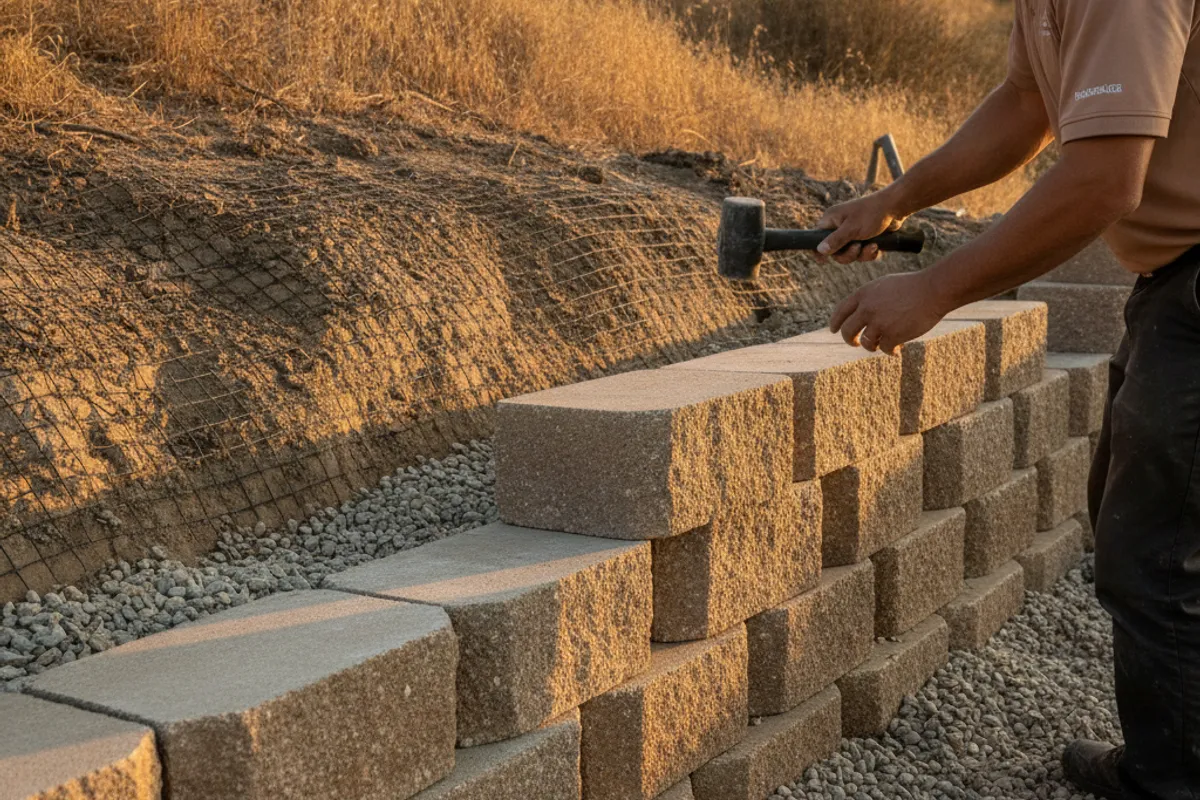
What segmental retaining wall block actually is
Segmental retaining wall (SRW) block is the concrete unit masonry system you see on most residential retaining wall projects in San Diego County. The blocks are precast concrete units engineered to stack without mortar, lock to each other through interlock or pins, and batter back slightly with each course so the wall leans into the hillside rather than standing straight up.
That setback angle, called batter, is not cosmetic. It shifts the wall’s center of gravity toward the retained soil and adds to the wall’s ability to resist overturning forces. Even a 1-2-degree batter per course over 10 courses creates a meaningful structural advantage over a vertical wall made of the same material.
SRW systems dominate residential work in San Diego for practical reasons: the blocks can be moved and placed without concrete trucks or cranes, installation does not require forming or curing time, the system drains naturally when properly backfilled, and it can be built in phases if a project needs to stretch across multiple days or seasons.
How a properly built SRW wall is put together
Understanding the construction sequence helps homeowners evaluate whether a bid includes the work that needs to be done.
Base preparation. The wall starts with a base course that is partially buried below grade. On flat ground or mild slopes, the base course might be 6-8 inches below grade. On steeper slopes with significant retained height, the buried depth increases. The base course sits on a compacted aggregate base, typically 6 inches of compacted 3/4-inch crushed aggregate. This base transfers load to stable ground and prevents settling.
Block placement. Each course is set with a consistent setback from the course below. Most SRW manufacturers have a setback built into the block geometry itself, so the blocks automatically batter as they stack. Courses are staggered so vertical joints do not line up from course to course, which distributes load laterally.
Drainage backfill. Directly behind the wall, the excavated native soil is replaced with clean drain rock, typically 3/4-inch angular gravel. This creates a permeable zone that water can move through instead of building hydrostatic pressure against the wall. A perforated drain pipe at the base of the drain rock zone collects water and carries it out past the wall face.
Geogrid reinforcement (for walls over 4 feet). On engineered walls, synthetic geogrid is laid horizontally at intervals specified by the engineer, extending back into the slope from the wall face. The geogrid anchors into the native soil and connects the wall face to the soil mass behind it, creating a reinforced zone that resists overturning and sliding much better than the wall face alone. Geogrid spacing and length are engineering decisions, not field judgment calls.
Compacted backfill. Once each geogrid layer is placed, the space above it is backfilled with native soil or structural fill and compacted. This is one of the places where shortcuts hurt: inadequate compaction creates settlement behind the wall that leads to cracking, leaning, and drainage problems over time.
Cap units. The top course uses cap blocks without a setback, creating a flat finished surface. Caps are typically glued with construction adhesive to prevent displacement.
SRW manufacturer systems worth knowing
Most SRW block in San Diego comes from a few manufacturers with established engineering data. That engineering data is what allows a civil engineer to design a wall to a specific height and load without custom testing.
Versa-Lok and Allan Block are two of the most widely used systems. Both have block geometries designed for structural performance, published engineering data at multiple retained heights, and geogrid specifications that integrate with their block units. Other manufacturers produce similar systems with similar engineering backstops.
Choosing a block from an established system matters because the engineer designs the wall to the manufacturer’s data. Using a different block without verifying it matches the engineering assumptions is a deviation that can affect wall performance.
What separates a well-built SRW system from a shortcut job
The shortcuts that show up in low-bid SRW work follow a predictable pattern.
Skipping drain rock and using native soil as backfill directly behind the wall. Native soil holds water, drain rock does not. This is the single most common shortcut and the most common cause of wall failure.
Skipping or reducing geogrid on engineered walls. Geogrid is not visible once the wall is backfilled. A contractor who leaves out geogrid layers or shortens the geogrid runs is cutting a significant structural element.
Inadequate base preparation. A base course set on poorly compacted or shallow base material will settle unevenly, causing the wall face to lean or crack.
Omitting the perforated drain pipe. Drain rock without a collection pipe works, but less efficiently. Water that cannot exit quickly enough still builds pressure behind the wall during heavy rain events.
When getting quotes, ask specifically: what is behind the wall (drain rock or native soil), is geogrid included if the wall is over 4 feet, and what is the base aggregate depth. Those questions sort out thorough bids from shortcut bids.
Wall Pro SD connects San Diego homeowners with insured local contractors who build SRW systems correctly. Call (858) 925-5546 to get connected with a crew that can evaluate your hillside and give you a real quote.
For more on segmental wall options, see our segmental block walls and Allan Block systems service pages.