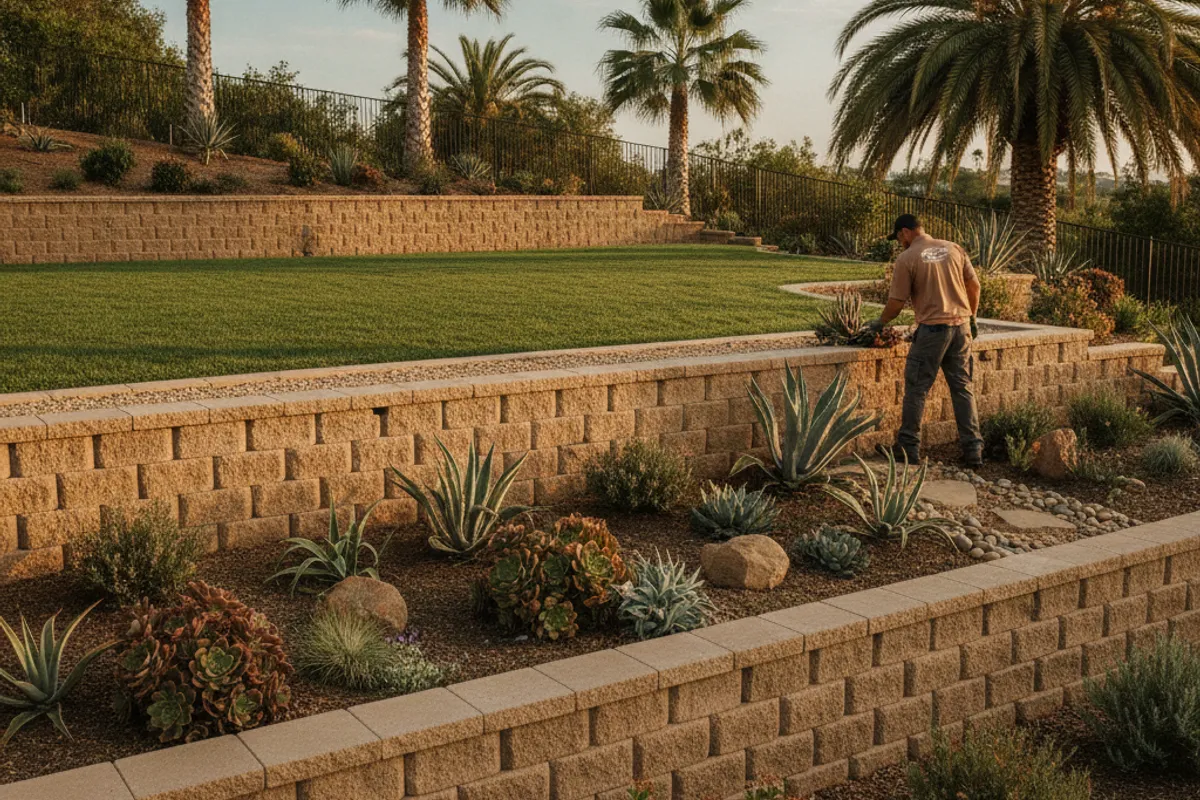
What terracing actually accomplishes
A steep backyard is one of the more common frustrations on San Diego hillside lots. The lot looks good from the street, the house is fine, but the yard is a slope that nobody uses. Kids cannot play on it, you cannot put a table on it, and it is expensive to maintain because a mower cannot run on a 40-degree hillside.
Terracing divides that slope into a series of flat levels separated by retaining walls. Each flat level (called a terrace or bench) becomes usable outdoor space, while the walls hold the grade change between levels. Done well, terracing can turn 1,200 square feet of unusable slope into three or four functional outdoor areas stacked up the hill.
It is one of the more transformative things you can do with a San Diego hillside lot, and it is also one of the more complex, because every retaining wall in a terraced system has to be designed and built correctly for the whole system to hold.
How terracing is different from a single wall
A single retaining wall holds a grade change in one place. Terracing means multiple grade changes in sequence, and the walls interact with each other in ways that matter for engineering.
The soil on the bench above a lower wall becomes the retained material behind the next wall up the slope. If water accumulates on a bench because drainage was not done correctly, that water pressure acts on both the wall below and the wall above. If a bench is loaded with soil that was not properly compacted, settlement happens at multiple levels.
Terracing also creates the tiered wall question mentioned in the permit section. Two walls with a narrow bench between them may be treated as a single combined structure for permit purposes. The horizontal width of each bench relative to the height of the walls below it determines whether each tier is structurally independent.
For a properly engineered terraced system, the engineer typically looks at the whole system as a unit, not as individual walls, and makes sure that loads from upper tiers are accounted for in the design of lower ones.
Typical terrace configurations for San Diego lots
Most residential terracing projects in San Diego work with one of a few common configurations.
Two-tier system. The most common. A single grade change of 6-10 feet is divided into two walls with a bench between them, each wall in the 3-5 foot range. If the bench is wide enough (typically at least twice the lower wall height), each wall can be engineered independently. A two-tier system on a typical Mission Valley or Tierrasanta hillside lot gives you one large flat area and one smaller elevated area.
Three-tier system. For steeper lots or larger grade changes, a third tier is added. Three walls and two benches. Each bench adds usable area, but the engineering complexity increases and the total project cost reflects that.
Deep single bench. For a moderate slope, sometimes one properly engineered wall with a single large bench below is the right answer, particularly if the lot allows for one substantial flat area rather than multiple smaller ones.
Front-yard terracing. In many hillside neighborhoods in Lemon Grove, National City, and the elevated areas of North Park, the front yard rises sharply from the street. Low terraced walls create planting areas that are both usable and attractive from the street while meeting height restrictions for front yard walls.
Cost ranges for a terraced system
Terracing costs more per square foot of usable area than a single wall, because you are building multiple walls, multiple drainage systems, and doing more grading. But you are also creating more usable area than a single wall provides.
A two-tier system with two walls in the 3-4 foot range, drain rock and pipe behind each wall, and compacted backfill on each bench runs $15,000-$35,000 for a typical San Diego residential lot, depending on the total wall footage, material choice, and whether engineering is required. Engineering and permits on walls over 4 feet add $1,100-$3,300 to the base cost.
A three-tier system on a steeper lot runs $25,000-$60,000 depending on the total retained height, the number of tiers, and site access. Lots with difficult access (tight side yards, no alley, steep approach from the street) add cost because all materials must be hand-carried or moved with equipment that fits the access.
Drainage is the critical system
In a terraced yard, drainage is not just behind each wall. It is across each bench, from bench to bench, and out of the lot to a safe discharge point.
Each bench needs to be graded with a slight pitch away from the upper wall toward the lower wall. Water that pools on a bench has nowhere to go except behind the next wall down, which adds to the load on that wall.
The drainage pipes behind each wall need to connect or discharge to a common collection system that carries water off the lot. If each wall drains to the face of the wall below it, and the water has nowhere to go after that, you get erosion, mud, and eventually structural problems.
Getting the drainage design right for a terraced system requires thinking about the whole slope, not each wall individually. This is one of the reasons that experienced contractors and engineers who have built multiple terraced systems in the county do better work than contractors who are treating each wall as a separate project.
Wall Pro SD connects San Diego homeowners with insured local contractors who have experience building terraced systems on hillside lots across the county. Call (858) 925-5546 to get connected with someone who can look at your slope and give you a realistic scope and cost.
For terracing projects in San Diego, see our terraced garden walls and drainage solutions for retaining walls service pages.