Retaining wall drainage in Lake San Marcos, CA.
Retaining Wall Drainage for Lake San Marcos homes, done by licensed San Diego County wall crews. Water trapped behind a retaining wall pushes on the face with hydrostatic pressure, and that pressure is what drainage exists to relieve. We connect homeowners with licensed local crews that design and install proper drainage systems: open-graded aggregate columns behind the face, perforated pipe at the base, and outlets to daylight that move water out before pressure can build.
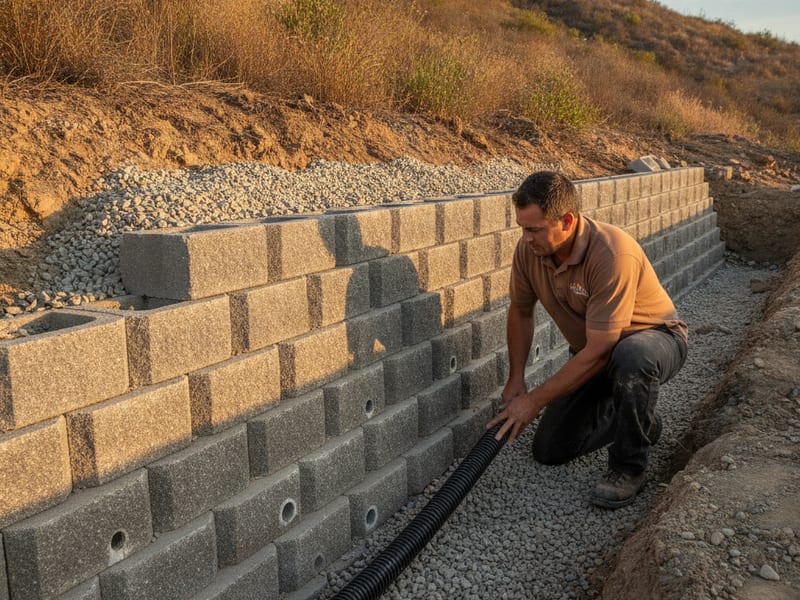
What makes retaining wall drainage different in North County Inland San Diego?
Decomposed-granite fill on North County Inland hillside lots drains fast at first, but the fine particles migrate into the wall's aggregate zone over time and clog the drainage column. Crews on these jobs wrap the aggregate column in non-woven filter fabric to prevent DG migration and inspect the outlet condition at least annually after installation. Filter fabric is not optional on DG-fill sites; without it, drainage capacity degrades within a few wet seasons.
What's included with retaining wall drainage in Lake San Marcos?
- Excavate behind the wall face and install a column of open-graded drainage aggregate (no fines) at least 12 inches wide
- Set perforated pipe at the base of the aggregate on a slight fall toward an outlet
- Run solid outlet pipe through or under the wall to daylight at a point that clears the slope and toe
- Wrap aggregate column with non-woven geotextile filter fabric to prevent soil migration into the gravel
- Install supplemental weep holes at the base of masonry walls where a pipe outlet is impractical
- Grade finished surface above the wall to shed irrigation and rain away from the backfill zone
When does a home in Lake San Marcos need retaining wall drainage?
- A retaining wall is visibly leaning, bulging, or cracking and drainage is suspected as the cause
- Weep holes in an existing wall are blocked or the wall shows efflorescence and mineral staining from trapped water
- A new wall is being built and proper drainage aggregate and pipe have not been included in the original bid
- A hillside irrigation system runs water into the slope directly behind a retaining wall face
- Winter rains regularly pool at the base of a wall or cause wet spots in the soil above it
What do Lake San Marcos homeowners ask about retaining wall drainage?
How do I get matched for retaining wall drainage in Lake San Marcos?
Call the number on this page and describe the wall. We match you with licensed local crews that cover Lake San Marcos, and the crew sets the on-site visit with you directly.
What is the cost of retaining wall drainage in Lake San Marcos?
Quoted per project after a site visit; on a new wall, drainage is part of the wall scope. Wall height, material, and site access drive the number far more than location does. The crew puts the price in writing after seeing the site.
How does Lake San Marcos's climate affect retaining wall drainage?
Inland community with a lake-effect microclimate, summer highs of 80 to 90 degrees, mild winters, and approximately 12 inches of annual rainfall. Much of the housing here predates the modern grading standards, so the age of the existing wall is what decides repair versus replacement. Decomposed-granite fill on North County Inland hillside lots drains fast at first, but the fine particles migrate into the wall's aggregate zone over time and clog the drainage column.
Why do most retaining wall failures involve drainage?
A retaining wall holds back soil, which has a certain weight at rest. When soil becomes saturated with water, the lateral pressure behind the wall can triple or quadruple. Walls designed for dry soil weight will lean, crack, or tip over when the soil behind them is wet and there is nowhere for the water to go. Every wall we connect you with gets proper drainage specified as part of the scope.
What is the right drainage material behind a retaining wall?
Open-graded crushed stone or pea gravel with no fines is the standard drainage aggregate for retaining walls. The material must be free-draining to work. Standard decomposed granite, sandy fill, or native soil does not drain fast enough and clogs over time. Aggregate is wrapped in filter fabric to keep soil from migrating into the gravel and reducing drainage capacity.
Need retaining wall drainage in Lake San Marcos?
Call and we match you with licensed local wall crews.